


Los padres como
Cuidadores remunerados
En el centro de Arizona
Nadie conoce mejor que usted las necesidades de cuidado de su hijo. El programa PPCG de Arizona permite que los padres reciban un pago por brindar cuidados domiciliarios aprobados.
La perspectiva del cuidador
Cómo funciona el programa PPCG de Arizona
Si usted es padre o madre de un niño con discapacidad en Arizona, probablemente ya esté desempeñando las funciones de un cuidador profesional. Arizona le permite recibir una remuneración por ese trabajo.
El programa Padres como Cuidadores Remunerados de Phoenix (PPCG) permite a los padres elegibles recibir una compensación por brindar cuidados domiciliarios aprobados y específicos para personas con discapacidad. No se trata de un programa de guardería infantil, sino de una compensación por cuidados excepcionales: el apoyo especializado y estructurado que va más allá de lo que un padre normalmente brindaría a un niño de la misma edad sin discapacidad.
Esta página explica cómo funciona el programa, quiénes cumplen los requisitos, qué cuidados son facturables, cómo se aplica el límite de 40 horas y qué sucede cuando se autoriza que su hijo reciba más cuidados de los que el programa permite facturar a los padres. UCP de Arizona Central ayuda a las familias a comprender su elegibilidad, completar la inscripción y garantizar que todos los cuidados autorizados estén cubiertos, incluidas las horas que excedan lo que los padres pueden facturar directamente.
¿Qué es el programa de Arizona para padres como cuidadores remunerados?
El programa Padres como Cuidadores Remunerados es un componente permanente del Sistema de Cuidados a Largo Plazo de Arizona. Permite que los padres o tutores legales de niños menores con discapacidades del desarrollo reciban una remuneración por brindar servicios aprobados en el hogar y la comunidad a través del Departamento de Discapacidades del Desarrollo (DDD).
Families can also review broader state-level caregiving support options and definitions via the Arizona Department of Economic Security (DES) Family Caregiver program page.
The program was established in 2020 as a temporary COVID-era measure. It became permanent in February 2024 under Arizona’s federal 1115 Demonstration Waiver. House Bill 2945, signed in April 2025, added operational safeguards, a residency requirement, and Electronic Visit Verification requirements that now govern the program’s operations. Families can rely on PPCG as a stable, long-term care model.
El programa compensa atención extraordinaria Solo se considera apoyo específico para personas con discapacidad aquel que excede lo que un padre o madre suele brindar a un niño de la misma edad sin discapacidad. Las tareas rutinarias de crianza no son facturables. Esta distinción es importante y se evalúa formalmente mediante el proceso de autorización del Departamento de Discapacidades del Desarrollo (DDD).
Requisitos de elegibilidad del programa PPCG para familias del centro de Arizona
La elegibilidad funciona en dos niveles. El niño debe cumplir con los requisitos y el padre o la madre debe cumplir con la definición de cuidador y los requisitos de residencia del programa.
Elegibilidad del niño
El niño debe estar inscrito en el Sistema de Cuidados a Largo Plazo de Arizona y contar con autorización para recibir Cuidado Personal, Rehabilitación o ambos a través del Departamento de Discapacidades del Desarrollo (DDD). El Coordinador de Apoyo del DDD asignado a su hijo determinará la autorización del servicio y la cantidad de horas semanales.
Elegibilidad de los padres
Para ser considerado cuidador remunerado, debe tener la custodia física o legal formal del niño y vivir en el mismo hogar. Los padrastros o madrastras deben haber completado la adopción legal para poder optar a esta opción. Otros requisitos incluyen:
- Tener al menos 18 años y poseer una identificación válida emitida por el gobierno.
- Poseer una tarjeta de autorización de huellas dactilares de nivel uno válida del Departamento de Seguridad Pública de Arizona (Arizona DPS).
- Debe pasar una verificación de antecedentes penales.
- Debe superar una verificación de antecedentes centralizada (CBC).
- Completar toda la formación exigida por el estado en un plazo de 90 días.
- Estar empleado o contratado a través de una única agencia HCBS autorizada.
Enfermeras tituladas y el programa LHA de Arizona
Si usted es auxiliar de enfermería o enfermero/a titulado/a, es posible que se aplique una vía de acreditación diferente a su caso. El programa de Auxiliar de Salud con Licencia de Arizona permite que los padres con un certificado LHA reciban una remuneración por la atención que requiere cuidados médicos complejos, como el cuidado de una traqueostomía o la alimentación por sonda. Además, bajo el programa PPCG, los padres que sean auxiliares de enfermería o enfermeros/as titulados/as pueden participar cuando brindan servicios de atención directa o rehabilitación. Si usted posee una licencia de enfermería, consulte con el equipo de Servicios Basados en la Comunidad y en el Hogar (HCBS) de UCP para saber si existe una vía de acreditación diferente que se ajuste a las necesidades específicas de atención de su hijo/a.
Requisito de residencia en Arizona
Según el proyecto de ley 2945 de la Cámara de Representantes, los padres deben haber residido en Arizona durante al menos seis meses consecutivos para poder optar a la prestación por cuidadores. Este requisito está sujeto a la aprobación federal de CMS como parte del marco de exención vigente del programa.
Regla crítica del programa: Solo puede inscribirse en una agencia. El programa prohíbe dividir los servicios entre varios proveedores. Por lo tanto, la elección de la agencia es una de las decisiones más importantes que tomará su familia.
Atención extraordinaria: lo que cubre el programa PPCG de Arizona.
El programa divide la atención en dos categorías. La atención ordinaria abarca las tareas de crianza rutinarias y apropiadas para la edad que cualquier padre realizaría. Estas no son facturables.
La atención extraordinaria abarca el apoyo específico para personas con discapacidad que requiere capacitación, estructura o orientación clínica. Esto es lo que compensa PPCG.
¿Qué se considera atención extraordinaria?
- Los planes de apoyo conductual requieren una implementación estructurada y consistente.
- Rutinas dirigidas por el terapeuta para necesidades sensoriales, físicas o de comunicación.
- Movilidad especializada o apoyo físico vinculado a la discapacidad.
- Atención médica o de higiene que va más allá de la crianza típica apropiada para la edad.
¿Qué no se considera atención extraordinaria?
- Tareas domésticas generales: lavar la ropa, preparar comidas, limpiar.
- Supervisión estándar adecuada para la edad del niño.
- Transporte a la escuela o a citas médicas
- Responsabilidades parentales rutinarias que cualquier padre desempeñaría
Cómo DDD determina las horas autorizadas: La herramienta de necesidades de HCBS y ECR
El Departamento de Discapacidades del Desarrollo (DDD) asigna las horas de servicio autorizadas basándose en una evaluación formal mediante la Herramienta de Necesidades de Servicios Basados en la Comunidad y el Hogar (HCBS Needs Tool). Existe un proceso de Revisión de Cuidados Extraordinarios (ECR, por sus siglas en inglés) para las familias que consideran que necesitan más horas de atención directa o de servicios de habilitación de las que indica la Herramienta de Necesidades de Habilitación. La ECR está diseñada específicamente para garantizar que la autorización refleje el nivel real de atención específica para la discapacidad que se requiere.
Nota: AHCCCS ordenó a DDD suspender el nuevo HNT en octubre de 2025 tras las inquietudes expresadas por las familias. Se está elaborando una normativa de emergencia para finalizar el proceso ECR. A las familias afectadas durante este período se les restituyeron los niveles de autorización previa. UCP supervisa estos cambios y se comunica directamente con las familias inscritas cuando se producen actualizaciones.
Servicios de asistencia y rehabilitación: Los dos tipos de servicios facturables
Bajo el programa PPCG, se facturan dos categorías de servicios. La autorización DDD de su hijo especifica cuáles se aplican y a qué nivel.
Atención personalizada (ATC)
| Se centra en las actividades de la vida diaria (AVD). |
| Mantiene la salud y la seguridad en las rutinas diarias. |
| Cubre el baño, el vestirse y el apoyo a la movilidad. |
| Aborda las necesidades de ayuda del niño hoy. |
| No se puede facturar durante el período escolar ni durante la hospitalización. |
Habilitación (HAH)
| Servicio orientado a objetivos y basado en las fortalezas |
| Desarrolla nuevas habilidades y aumenta tu independencia. |
| Abarca habilidades de comunicación, autodefensa y vida diaria. |
| Se centra en lo que el niño puede aprender a hacer de forma independiente. |
| No se puede facturar durante el período escolar ni durante la hospitalización. |
Es posible que su hijo/a esté autorizado/a para uno o ambos tipos de servicio. El equipo de Servicios Comunitarios y Basados en la Comunidad (HCBS) de UCP revisa el plan de servicios actual de su hijo/a con su Coordinador/a de Apoyo de DDD para confirmar qué servicios son facturables según su autorización específica.
Restricciones de facturación que se aplican a ambos servicios
- Los servicios no se facturarán mientras el niño esté en la escuela.
- Los servicios no se pueden facturar durante la hospitalización o la atención clínica, a menos que se cumplan ciertos criterios de exención.
- Los servicios deben prestarse entre las 6:00 y las 22:00 horas, a menos que el plan de atención especifique lo contrario.
- Los servicios de limpieza, lavandería y preparación de comidas no son facturables.
El límite de 40 horas semanales y el puente del UCP
Muchos niños tienen autorización para recibir más cuidados de los que los padres pueden facturar. Esto crea una brecha estructural entre las necesidades de su hijo y lo que el programa le permite reclamar como cuidador. El programa no reduce la autorización para su hijo; simplemente modifica quién está autorizado a brindarle esos cuidados.
A partir del 1 de julio de 2025, los padres cuidadores que participen en el programa PPCG podrán facturar hasta 40 horas semanales por niño. Si dos padres prestan servicios al mismo niño, el total de horas trabajadas no podrá exceder las 40 semanales.
Un detalle que muchas familias con varios hijos inscritos en el programa DDD desconocen es que el límite de 40 horas se aplica por niño, no por familia. Si usted es padre o madre y presta servicios a dos niños, cada uno autorizado para recibir atención bajo el programa PPCG, puede facturar hasta 40 horas semanales por cada niño, para un total combinado de hasta 80 horas semanales. Las horas de cada niño se registran y limitan por separado.
Se trata de un límite de facturación, no de un límite de atención médica. Muchos niños tienen autorización para estar fuera más de 40 horas. Esas horas restantes aún deben cubrirse. El programa no permite que los padres les cobren.
La mayoría de las agencias de HCBS procesan las 40 horas de los padres y dan por finalizado el servicio. Las familias deben buscar, evaluar y coordinar una cobertura adicional por su cuenta, sin dejar de estar vinculadas a su agencia original bajo la regla de inscripción única.
UCP del centro de Arizona opera de manera diferente. Lo llamamos El puente UCP. Cuando se autoriza el cuidado de un niño más allá del límite de 40 horas establecido por los padres, el equipo de cuidadores cualificados de UCP ayuda a cubrir las horas autorizadas restantes, coordinado directamente con su familia, bajo la misma inscripción.
Una sola agencia. Un solo plan de atención. Sin lagunas.
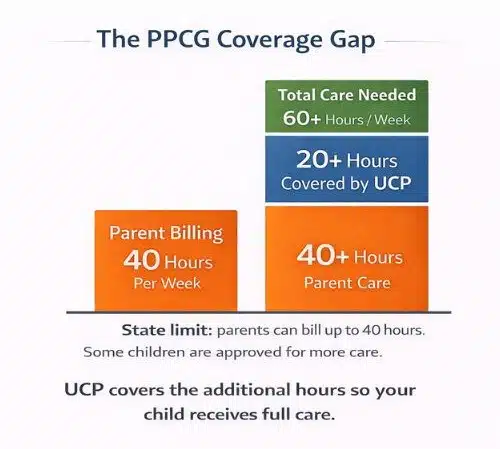
El estado limita la facturación a los padres a 40 horas. El programa UCP Bridge ayuda a completar las horas autorizadas restantes. Una sola inscripción, cobertura total. Esa es la diferencia estructural entre un procesador de facturación y un socio de servicio completo.
Legislación estatal y lo que significa para las familias
La Legislatura de Arizona revisa periódicamente los servicios y presupuestos del Departamento de Discapacidades del Desarrollo (DDD), incluido el programa PPCG. UCP monitorea activamente estos cambios y comunica directamente a las familias inscritas.
PPCG para miembros adultos: Cómo cambia el programa al cumplir 18 años.
La estructura del programa cambia en la edad adulta. Para los padres de hijos adultos inscritos en ALTCS, la limitación de 40 horas semanales no se aplica, pero está sujeta a restricciones de horas extras.
As your child transitions into adulthood, finding consistent daytime support and community connection becomes a priority. Through our ArizonAbility Adult Day Program, participants gain access to specialized, community-based day support for adults.
If your child is approaching 18 and you are currently enrolled as a PPCG caregiver, UCP’s HCBS team will work with you and your DDD Support Coordinator to ensure a smooth transition into the adult caregiving structure before any disruption occurs.
Requisitos de capacitación del PPCG para padres cuidadores en Arizona
Antes de que comience la facturación, los padres cuidadores deben completar la capacitación aprobada por el estado, someterse a exámenes médicos y obtener la certificación en RCP y primeros auxilios. Se requiere educación continua anual para mantener la condición de trabajador de atención directa.
UCP proporciona o coordina toda la capacitación requerida como parte del proceso de inscripción. Los requisitos específicos de horas de capacitación son establecidos por AHCCCS y DDD y están sujetos a cambios. UCP confirma los requisitos vigentes con cada nuevo inscrito. No publicamos aquí el número exacto de horas para garantizar que la información que usted recibe esté siempre actualizada.
Cumplimiento de EVV y facturación bajo el programa PPCG de Arizona
Todos los servicios de PPCG están sujetos a la Verificación Electrónica de Visitas (EVV). EVV registra la atención en tiempo real y crea un registro auditable de cada sesión. El incumplimiento afecta el pago. UCP proporciona las herramientas y la capacitación necesarias para completar EVV correctamente desde el primer día.
¿Qué graba EVV?
- Fecha, hora de inicio y hora de finalización de cada sesión de atención.
- Ubicación del servicio de entrega
- Identidad del cuidador
- Tipo de servicio: Cuidado personal o rehabilitación, por cada sesión.
Errores comunes de facturación que se deben evitar
- Facturación durante la asistencia escolar o las citas clínicas
- Facturación por tareas domésticas no vinculadas a la atención específica para personas con discapacidad.
- Ambos padres facturan las mismas horas dentro del límite compartido de 40 horas.
- Facturación fuera del plazo aprobado sin documentación del plan de atención.
Consideraciones fiscales y de compensación de PPCG para familias en el centro de Arizona
Las tarifas de compensación las establece la agencia empleadora dentro de la estructura tarifaria publicada por DDD. No las establece el estado. Al inscribirse en UCP, nuestro equipo de HCBS le explicará directamente su estructura de compensación. Las tarifas de compensación dependen de los servicios prestados.
Exención fiscal por dificultad de cuidado
Dado que usted vive en el mismo hogar que la persona a la que cuida, sus ingresos como cuidador/a de personas dependientes podrían calificar para la exclusión del impuesto sobre la renta por dificultades en el cuidado, según el Aviso 2014-7 del IRS. Si esto aplica, sus ingresos podrían quedar excluidos del ingreso bruto federal. Sin embargo, podrían aplicarse impuestos del Seguro Social, dependiendo de su estructura laboral. Consulte con un asesor fiscal especializado en acuerdos de cuidado de personas dependientes de Medicaid para obtener orientación específica para su situación.
AHCCCS puede proporcionar una verificación del miembro del hogar inscrito en ALTCS para respaldar esta exclusión. Para solicitar dicha verificación, comuníquese directamente con AHCCCS al (602) 417-4230 o (855) 842-7619, o por correo electrónico a [email protected].
Impacto en otros beneficios
Los salarios de PPCG son ingresos del trabajo. La forma en que afectan la elegibilidad de su hogar para otros programas depende de dos factores: si se aplica la exclusión por dificultad de cuidado y en qué programas específicos de AHCCCS participa su hogar.
Si sus salarios califican para la exclusión por Dificultad de Cuidado, se excluyen de los cálculos del Ingreso Bruto Ajustado Modificado. Esto significa que esos salarios pueden no contar para los umbrales de elegibilidad de AHCCCS para programas basados en MAGI. Sin embargo, los salarios ganados por brindar atención a un ALTCS Los miembros que no viven en su hogar no reúnen los requisitos para esta exclusión y se consideran ingresos regulares.
Para programas que no pertenecen a AHCCCS, como SNAP, los salarios de PPCG se consideran ingresos del trabajo y pueden afectar la elegibilidad. Revise la situación completa de los beneficios de su hogar antes de inscribirse.
Por qué la agencia de servicios comunitarios y domiciliarios que elija en el centro de Arizona determina sus resultados
Dado que el programa requiere la inscripción a través de una sola agencia, la agencia que usted elija controlará la facturación, el cumplimiento normativo, la capacitación, la coordinación con DDD y la cobertura de las horas de atención que excedan el límite establecido para los padres. Cambiar de agencia requiere un proceso formal de reinscripción.
Es posible que su hijo/a esté autorizado/a para uno o ambos tipos de servicio. El equipo de Servicios Comunitarios y Basados en la Comunidad (HCBS) de UCP revisa el plan de servicios actual de su hijo/a con su Coordinador/a de Apoyo de DDD para confirmar qué servicios son facturables según su autorización específica.
Algunas agencias funcionan únicamente como gestoras de facturación. Se encargan de los trámites administrativos y nada más. Cuando la autorización para el cuidado de su hijo supera las 40 horas, una agencia que solo se dedica a la facturación deja a su familia la tarea de coordinar la atención adicional por su cuenta.
UCP opera un modelo de servicio integral basado en el programa UCP Bridge. Contamos con nuestro propio equipo de cuidadores calificados. Si su hijo requiere más atención de la que el programa permite facturar a los padres, el equipo de UCP ayuda a cubrir las horas restantes bajo la misma inscripción.
Una agencia. Cobertura completa.
Antes de inscribir a su hijo/a en cualquier agencia, pregúnteles directamente: ¿Qué sucede cuando mi hijo/a recibe autorización para asistir a más de 40 horas semanales? La especificidad de la respuesta le indicará cómo esa agencia atenderá a su familia.
Cómo inscribirse en PPCG con UCP de Arizona Central
UCP of Central Arizona es una agencia HCBS autorizada que presta servicios a familias en toda el área metropolitana de Phoenix y el condado de Maricopa, incluyendo Phoenix, Mesa, Scottsdale, Tempe, Chandler, Gilbert y las comunidades circundantes. UCP of Central Arizona es una agencia HCBS autorizada que presta servicios a familias en toda el área metropolitana de Phoenix y el condado de Maricopa, incluyendo Phoenix, Mesa, Scottsdale, Tempe, Chandler, Gilbert y las comunidades circundantes.
- Primer contacto. Comuníquese con [email protected]. Hablaremos sobre la autorización DDD actual de su hijo y su proceso de elegibilidad.
- Revisión de autorización. Nuestro equipo de HCBS revisa el plan de servicios de su hijo en coordinación con su Coordinador de Apoyo de DDD. Confirmamos qué servicios son facturables y la estructura de tarifas semanales por hora.
- Acreditación. Complete la solicitud requerida por UCP, la verificación de antecedentes penales mediante huellas dactilares y la documentación del trabajador de atención directa. Le guiamos en cada paso.
- Formación obligatoria. Completa la capacitación obligatoria estatal. UCP coordina y confirma que cumples con todos los requisitos.
- Coordinación de servicios. Si la autorización de su hijo supera el límite de 40 horas para los padres, se activa el programa UCP Bridge. Nuestro equipo de cuidadores ofrece apoyo para completar las horas autorizadas restantes.
- Configuración y soporte continuo de EVV. Configuramos sus herramientas de verificación electrónica de visitas, le guiamos en el proceso de facturación y seguimos siendo su punto de contacto permanente para las actualizaciones del plan y la coordinación de la DDD (Dispositivo de Determinación de Discapacidad).
Las familias con un plan de servicios DDD activo y vigente suelen completar el proceso de inscripción de manera más eficiente. Si el proceso DDD de su hijo aún está en curso, contáctenos. Organizaremos la inscripción de acuerdo con su cronograma de autorización.
Preguntas frecuentes
¿Qué ocurre si mi hijo necesita más de 40 horas de atención?
Si la autorización para el cuidado de su hijo supera las 40 horas semanales, los padres pueden facturar hasta ese límite. Las horas restantes deben ser cubiertas por un cuidador calificado que no sea el padre o la madre. Algunas agencias exigen que las familias coordinen esta cobertura por su cuenta. UCP brinda apoyo para coordinar las horas restantes a través de nuestro equipo de cuidadores.
¿Cuánto tiempo tarda la aprobación de PPCG?
Los plazos varían según la etapa del proceso DDD y ALTCS en la que se encuentre su hijo/a. Las familias con una autorización DDD activa pueden completar la inscripción más rápidamente. Si aún se está determinando la elegibilidad, el proceso puede demorar más debido a los plazos de evaluación y aprobación estatales.
¿Cuánto paga PPCG en Arizona?
Las tarifas de compensación varían según la agencia y el tipo de servicio. Estas tarifas dependen de si los servicios son de asistencia personal o de rehabilitación, así como de la estructura de la agencia. UCP explica la compensación directamente durante la inscripción para que las familias sepan exactamente qué esperar.
¿Puedo tener otro trabajo mientras cuido de un padre o madre?
Sí, pero los servicios de PPCG deben prestarse en un horario distinto al de cualquier otro empleo. No puede facturar los servicios de PPCG durante las horas en que esté trabajando en otro lugar.
¿Los cuidadores familiares tienen que pagar impuestos?
El tratamiento fiscal puede variar según las circunstancias individuales. Algunos salarios pueden acogerse a la exclusión de ingresos por dificultades de cuidado del IRS. Le recomendamos consultar con un asesor fiscal o revisar las directrices del IRS para comprender su situación particular.
¿Qué empresa te pagará por cuidar a un familiar?
UCP of Central Arizona es una agencia líder con licencia en Phoenix que emplea a miembros de la familia como cuidadores profesionales.
¿Pueden ambos padres recibir un salario?
Sí. Ambos padres pueden estar inscritos y recibir compensación. Ambos deben estar inscritos a través de la misma agencia, y sus horas semanales combinadas no pueden exceder el límite de 40 horas. UCP coordina ambas inscripciones bajo una misma estructura.
¿Puedo proporcionar cuidados remunerados para mi hijo cuando esté hospitalizado o en un entorno clínico?
No. Las regulaciones estatales prohíben estrictamente que los padres cuidadores facturen por servicios cuando el miembro de ALTCS está recibiendo atención en un entorno hospitalario, como un hospital, centro de enfermería especializada, o durante un cita de terapia programada. El programa PPCG está diseñado específicamente para brindar atención personalizada en el hogar. Cuando su hijo se encuentra en un entorno clínico, el centro médico es responsable de su cuidado. Usted puede estar presente como padre o madre, pero no recibirá compensación económica como cuidador durante esas horas.
¿Qué sucede si la autorización de mi hijo cambia después de que lo matricule?
Los niveles de autorización se revisan periódicamente y pueden cambiar según la reevaluación. El Programa de Atención Integral (UCP) se mantiene en coordinación con su Coordinador de Apoyo de DDD para que los cambios en el plan de servicios de su hijo se reflejen con prontitud y no generen interrupciones en la atención ni en la facturación.
¿Mi hijo tiene que ser menor de 18 años?
No. El programa se aplica a menores de edad, pero AHCCCS también permite que los familiares cuiden a sus hijos adultos inscritos en ALTCS. Para los adultos, no se aplica la limitación de 40 horas semanales, pero sí las restricciones de horas extras.
Inscríbase en PPCG con UCP de Arizona Central.
Si su hijo está inscrito o es elegible para los servicios de DDD en el centro de Arizona, el siguiente paso es una conversación, no un compromiso. El equipo de HCBS de UCP revisará la autorización actual de su hijo, le explicará cómo funciona el PPCG en su estructura familiar específica y responderá a todas sus preguntas antes de firmar cualquier documento.
Programe una revisión de elegibilidad local. Nuestro equipo especializado está listo para ayudarle a formalizar su rol y maximizar el apoyo a su familia. Correo electrónico: [email protected] Damos servicio a Phoenix, Mesa, Scottsdale y las comunidades circundantes del Valle.